Tuesday, March 25, 2014

Usually we have limited our offerings to working cattle and occasionally responsible living. There are other things going on out here. As I am sure you have picked up, we have a relaxed relationship with lots of other animals.  For example, the local flock of turkeys knows that I feed the oxen and that they will get the scraps. OK, so I do throw them an occasional handful of grain from time to time. They have not been hunted here for two decades. So they have no fear of me and are willing to come very close to steal a bite to eat.


The deer come to our salt blocks and eat out of our hay feeders. Since they intermingle with the oxen, and the oxen act like we are safe, they think we are safe. Another example, I had a doe give birth an hundred feet from me the spring before last.  Deer almost walk up to us. I’ve posted this before, but Maria thinks it is because we are vegetarians we do not smell like predators. Certainly the local bird population thinks we are the source of food.  I have to brush birds off the feeders to fill them.  We just got a laugh out of a determined Titmouse that continued to feed at the tray of the feeder while I was filling it. They are pretty sure we are safe. Our barns are home to two Rat Snakes, both have no fear of us at all. So this is a strange little chunk of the country. I am going to post more about this in the future.

Tuesday, February 4, 2014

When times are tough, you want oxen. We had an unusual string of weather. The forecast for Sunday was some sleet followed by snow flurries. Instead it rained heavily for hours then froze and ended with a dusting of snow. The rain washed down blocks of ice from up in the hollow and blocked both bridges. Everything was covered with a quarter to a half inch layer of ice. It flooded enough to leave two logs on the Delk Branch Road bridge. It took me five minutes with two sets of pliers to get the gate latch open to let Floppy (our milk goat) out to be milked. Four of the oxen met me by the barn to tell me they wanted hay. They weren't out of hay, it was frozen so solid they couldn't eat it. George knew we would move hay and stayed by the feeder at the other end of the pasture. I fed them and William went immediately to the sledge. I could not get the frozen hay off the sledge by hand and had to use the oxen and a logging chain to pull it off. The sledge was frozen to the ground. George and William leaned into it and it didn't move. Then before I could give another command both leaned back in unison and lunged. That broke it loose. The outer layers of the round bale were frozen to the ground and peeled off. It took three tries to load the bale. The bridge was so icy that I didn't want to risk the oxen on it. It is a low water bridge with no railings or side walls. I extended the chain and had them stay on the bank and pull the logs off. That was yesterday. No matter how hard things were they just patiently stayed with me. Love oxen.

Saturday, January 25, 2014

This is the hay feeder in use yesterday. That was the second day with this bale on it. It is down about a quarter today. I should get four or five days out of a bale with this system. The advantages are we built it largely with scraps that were around the farm. If you bought everything it would cost about $150 or about half the cost of a store bought hay feeder. Then, the cattle can move it. They load it by rolling the bale onto it and pull it into the pasture. It is a lot less work than trying to lift up one of the steel round bale feeders and move it over a roll. The drawing is rough, basically I just wanted people to see how I did it. I don't think anyone is going to want to slavishly copy my design. With the images here and on the last blog post you should have a good idea how to make one of these and I'll give any advice I can.
 (


Thursday, January 16, 2014


Moving Hay


Our old hay feeders have fallen apart; a combination of age and really big cattle.  I decided this time I would make my own and combine the feeder with a sledge the oxen could move.  I built it last week, and today was the third time I have used it.  The first test run had a glitch.  The eye bolts were not strong enough.  So I bought some ½ inch eye bolts at the local hardware store and tried it again.  Sunday’s feeding went perfect.  We photographed today’s excursion just in case it would help anyone.


The sledge is eight feet long by five feet wide.  I used four 2”x12”x8’ for the runners bolted together in pairs. I looked at the old hay feeders and the barrier was two feet high. I thought this was a wise starting point to keep the cattle out of the hay. It worked. It is double ended with eye bolts at both ends so it can be pulled in either direction.  It has sideboards to keep the cattle from standing or lying in the hay. I also added eye bolts on the sides in case I wanted to tie a load onto the sledge.

 The way we use the feeder is to have two oxen take it to the hay yard, roll a bale on the sledge, pull it back to the pasture, I unhook them and we are done for a half week or so.


The process starts by calling George and William in to be yoked. The other cattle are supposed to stay out of the way, they don’t always.


The boys are awfully cooperative about  yoking and going to work.


Next I hook the chain to the sledge with clevises.


And I hitch the chain to the yoke using another clevis. I know we could use other systems, but I've never had a clevis fail.


With the boys hitched we open the gate and tell them to go.  They have no problem getting a five foot wide sledge through a six foot wide space. This shot also gives you a view of what the chain looks like without a lot of clutter.


The boys position the sledge next to a bale.

 
I unhook the chain.


Next I pull the sideboard off the sledge next to the bale.


I drive a barn spike into the bale,


And snag it with the grab hook of a logging chain.


The boys know exactly what they are doing and it takes minimum direction to get them lined up on the chain and bale.


We didn't get a good picture of it today but this is how we are hooked to the bale.

 
In a second or so it is up on the sledge.


I put the sideboard back on.


Pull the spike out and put it and the chain on the next bale.


Tell George and William to go to the other end of the sledge.


 Connect the chain and we head for the pasture.


Where, of course we are greeted by my starving cattle.


I unyoke the boys on the spot, giving each a good scratch and telling how good they did.  I put the yoke and chain away and we are done.  I think the only correction was telling William he could not munch grass once when he was waiting.  There were minimum commands and a lot of “Good!” The process took about fifteen minutes.

Friday, February 8, 2013


The oxen have worked four out of the last five days.  Big jobs like moving hay, small stuff like moving tools and equipment, pulled a tree down that was hung up on another tree and hauled a stack of hog panels out of the woods where a neighbor had disassembled a pig pen.  When they are working like this they get good.  The mud was so bad that the sledge was sunk up to the floorboards with average size round bales on it.  They did it perfectly, putting everything where I wanted it, never faltering. It had to have been tough going.  I had to use two of them to pull the hay rings out of the mud.  Loading the bales, George and James had to hold them in place because otherwise they would roll off the sledge; never a mistake.  Yesterday, pulling the hog panels down, it was an obstacle course, threading their way through the trees with twelve sixteen foot panels behind them.  We never even brushed a tree.

When we have done something like this, George in particular watches me until I tell him he did a good job.  His body is tense.  The others do it too, but it is less pronounced.  They don't relax until I reassure them that they did it well.  I find myself wondering if all my oxen were like this and I just was too dumb to see it.  This bunch really works for praise and reassurance.  That may be the key to working any animal.

Saturday, June 16, 2012


Springtime


The spring travel season is over.  I now have a summer to get things done around the farm and write.  I am armpit deep in writing a novel about the Viet Nam War.  Hated the War.  This is going to be an ugly, dark novel that will never sell, but it is cathartic.  I have never written anything else on Viet Nam, but I need to get this one off my chest.  The tentative title is, No Name.  Probably only a quarter ofmy titles survive the rewrites.

While I am on writing, By Lantern Light is on Kindle.  Some Thoughts on Scouts and Spies continues to do reliably.  An article on the oxen, entitled “The Four Kings” will come out in the July/August issue of Muzzleloader.

The oxen have treated us wonderfully.  They certainly have been reliable.  They have worked eight times this spring.  We have a new milk goat, Daisy.  She is a Boer.  I know Boers are not known for being good milkers, but Daisy gives about a quart a day and it does not have that goat smell or taste.  We got lucky.  She is an absolute sweetheart and follows us around like a dog.

There is a pair of wild turkeys that have figured out that I have grain in buckets and wil not run from me any longer, instad they wait for me to give them a scoop.  Now they have influenced another Jake who is not running.

Jake Yoste is in the Army at Fort Sam Huston taking Medical Training.

Tuesday, February 28, 2012

Springtime

After a nice winter of hibernation (mostly writing, I have finished a book of short stories and another novel set in Colonial Virginia) it is time to come out of the cave.  Two litters of pigs in the same day.  The oxen are rusty even though they have done some logging and moved hay regularly.  I now have four weeks to prepare for Shiloh.  We will be part of the march from Corinth.  So, we train animals, condition them and hopefully in the process get me back in shape for a good long walk.

Sunday, July 17, 2011

Bright

                                          Jake driving Bright

About half way through training Bright, a three year old mare belonging to a man in Marrowbone. She is an intelligent, and dominant creature who will try to dominate a human if she can. Like many strong willed horses, she is very alert and spooks at more things than most less dominant animals. The training has gone well. We started her in a round pen. We isolated her in the beginning. I got her moving then taught her that she did not have to fear the halter or being led. We kept it short. Being led got her to grazing, friends, treats and water. Because she was isolated, my coming was anticipated and whatever I did was seen as beneficial. When we moved her to a semi-isolated pasture by the barn, the pattern continued. She comes in for training at a run. We do give her treats, but we also give lots of praise, neck rubs, and scratching.

We started with driving. She has not had experience with the whip. To start her I pushed on her rump. From the very beginning I tried to cue her with the lines and release as soon as she started the move. She now has this pretty well mastered. I always accompany the cuing with the lines with voice commands. I notice she will do many of the moves on voice alone. We use “gee”, “haw”, “up”, “whoa”. and “back”. I use “haw about” for a complete “U” turn to the left, and she now understands that the “about” command means a full 180o turn. We added being saddled and having weight put on the saddle these past few days. Jake got on her the day before yesterday, and she simply inspected him. No resistance at all. Yesterday she gave us a big unload while he was sitting there.

All along we have worked on grooming, spraying her with fly wipe and handling her feet. Now, after a week, she is comfortable with all of them. She stood for being sprayed with fly wipe yesterday completely unconcerned with the process. She gives me the front feet, but I still have to pick up the hinds. I brush her feet with the grooming brush and rap on them with the back of the brush.

The past two days we have begun the process of teaching her that other people can drive her too. She is not nearly as well behaved for other drivers. I have had the problem of creating one man animals in the past. I have had Joe, Jake and Maria drive her. I tell them not to correct, just praise. I want her to think that all people are safe and beneficial.

What I think is most promising is that she has gone through half her training with only one scolding. The second time I tightened the cinch on the Western saddle, she kicked at me. I got in her face for that. Other than that, things have been calm. I do not punish for not knowing or for acting like a horse. We just do things over until she gets them right. We had a bit of a balking problem in the beginning. Everything was scary. Maria thinks she was using it for attention. We just kept working on it. The last couple of days we haven’t seen this at all.

I don’t think I’d call her green broke yet, but I know I have been around horses a lot rawer than Bright is that were released as green broke. I do not think that our low key, non-confrontational approach has added a minute to the length of training time. One thing is for sure, she likes human contact. We would not have had that with a rougher style of training. That in itself will make all future training easier.

Thursday, July 14, 2011

We the People

We citizens of these United States have developed an extremely effective way of destroying ourselves. We have decided to stay in our golden past. We have refused to be brought into the modern world. Then, we accuse anyone that points out our problems of lack of patriotism. This guarantees that nothing will ever improve. We will simply slide loudly and with a large splash into oblivion.
We used to think that the Oriental history of walling out change that kept China and Japan from modernizing for centuries was ridiculous. If you look at the present state of our country, you will see that this is exactly what we have done. We don’t learn from the past, we glorify it. We try, very unrealistically to live in it.
We developed a political system that was extremely responsive to the needs of a rapidly industrializing nation. Our government supported industry, commerce and the stockholders that managed our leap into world prominence. Now we are held hostage by these same forces that built us, and we cannot let go.
We failed to automate our industry; to protect the workers‘ jobs, of course. We hamstrung our agriculture by permitting a monopoly to pick the direction it would go, without thought to any consequence but profit. Oil built us. American oil won World War II, and even though the handwriting has been on the wall for fifty years, we refuse to let go of it. The oil companies are diversifying, buying into renewable energy, but we, as a people, are not. Climate change is going to redesign the world’s economy for us. Our leaders stick their heads in the sand. Prudence would dictate that if there were even a chance that this would be barreling down the slope toward us that we should take concrete measures to save ourselves. But we are not prudent people. Fourteen percent of our workforce is unemployed as of this writing. About the same percentage are underemployed. We did this to ourselves. We allowed businesses to move these people’s jobs overseas and bring the products back to this country without any tariff whatsoever. That is freedom.
We are not a democracy. This country was designed as a vehicle for corporate profits. It is business that pays for the campaigns that put people in political office. Therefore, we get leaders and legislators who put the interests of sponsors first. Look at the decisions they have made over the past years. Republican or Democrat, neither party will vote against the interests of big business. The Constitution is simply a panacea. This country is run by an unwritten constitution that exists to insure corporate profits and the welfare of the economic elite. The rest of us are manipulated. We are given bread and games. The term for this form of government is plutocracy

Wednesday, June 29, 2011

Pigs

Busy trying to improve our energy usage and fit in trips and still have time for writing.  Just got another article written yesterday.  At evening chores, the three little pigs were loose.  I think it proves that all animals are better trained.  Because of the bucket training, that took no time at all, they came right up to me, followed me into the pen, and let me scratch them outside the pen.  It could have been a difficult situation if they has still been afraid of humans.

Sunday, May 15, 2011

Springtime

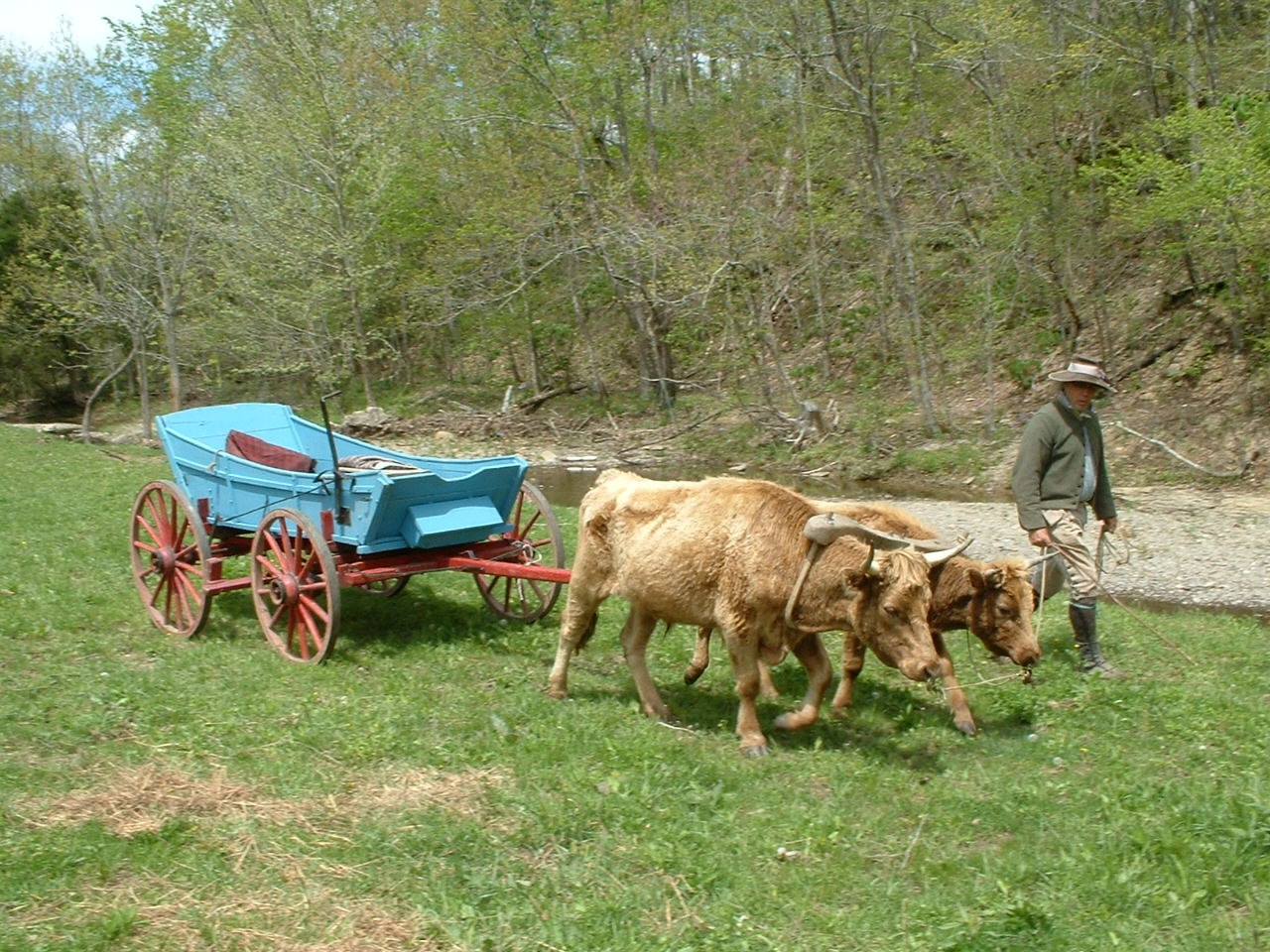
We are in the springtime cycle of events and farming. Get home, rush around breathlessly trying to catch up, pack for another event and off again. The oxen are wonderful at it. We see endless children and somehow the oxen just seem to be a bottomless pit of patience. There has been more interest this year in using oxen for subsistence farms and other small or hobby farm applications. I still think that if all I had was a kitchen garden a single ox would be the most practical of all draft animals.

We learned another use of a word in cattle language. We have always known that shaking the horns from side to side was a challenge. I called the oxen into the paddock by the barn. James came in before George and was standing well away from his feed pan blocking George's path. When George came in, he shook his head from side to side. James did not panic as if he had been challenged by a dominant animal, he just simply moved up out of George's way. I think the context gave this signal a different meaning. It gives me something else to look for in their language.

Charlie continues to show his complete understanding of fences. Bright is separated from the other horses for training. I fed her in the round pen. As soon as I walked away, Charlie used his horns to pick up the round pen and move it past Bright's feed pan so he could get at her food. A second incident, I fed the pigs the other day. Charlie left his food to go dismantle the pig pen to get their food. He is back staked again for everyone's protection.

Monday, March 7, 2011

Springtime

The well pump gave up the ghost. I called customer service for Sure-Dri and they told me that it probably died of old age. Our choice is basically to replace it with something we know will be phased out shortly or go solar, in which case we are going to have to redesign the water system.

Spring is definitely upon us. Grass is definitely growing and the animals are choosing to eat more grass and less hay. I do not want to move them to the south pasture until the grass there is a little further along. For the present, I have been working on fences. Not much else can be done until the ground dries out a little more. We planned the gardens and staked the corners. If rain will hold off a little more, I plan on disking the plots this week. We now have a complete if not fleshed out Farm Plan. Hopefully this will keep us from making wasteful detours.

When the plan is finalized, we may post it but for now, a summary might help some people. We are continuing our pursuit of alternate energy sources. While this is still in the research stage, we are going to have to move on some of it right now. Certainly the pump, and probably the solar oven will top the list. Second, we are working on becoming more self sufficient. Of course, generating our own energy is part of this, but so is growing our own food. We are going to pursue building a house on the hill. This would give us a better site for both solar and wind energy. Obviously, this cannot be done immediately, thus there have to be both long term and short term goals.

At evening chores I watched the cattle play dominance games. George and Charlie squared off. George had his horn ridge just below Charlie’s, the points of his horns in Charlie’s forehead. Charlie’s horns did not connect with anything. George pushed Charlie back about three feet whereupon Charles quit and decided to go after William. Will stood up to him and Charlie pushed William back a few yards until he sat on his rump in the mud. James wanted no part in the games and came over and stood by me.


This morning I saw a scarlet Tanager.

Springtime

Sunday, March 6, 2011

Oxen

I was running through the photo collection and found a few that have not been seen very often.

Monday, February 28, 2011

Blending Philosophy With Reality

It was 73o, I saw both robins and mocking birds, the first buds are on the trees and shrubs and we had another thunder storm. The chickens gave us four eggs again today. The sow Isabella slimed my leg while I was cleaning out her water pan. We had to move hay again. The oxen sensed that it was a work day and met me at the gate all ready to work. Joe thinks George checks the depth of hay in the rings and knows when we are going to work them. William moved into position to take the yoke without being told and later got on the chain when he was told without prompting. Spring is battering on the door. We are talking about gardens and starting to plan.

The real issue is not what we are going to plant, or where. The question is how we make sustainable living a lifestyle. We have to factor in shelter, transportation, food storage, and clothing and provide food. We need sources of information and enough money to give us some maneuverability and acquire capital items needed to transform the farmstead. This is a tall order. Some things are obvious. The house is inefficient: Too much wasted space, poor insulation and a site that is someday going to get wiped out by a flood. We want to build a more survivable house up-hill where it will get more solar energy and pick up more wind. We have steadily reduced our use of the car and truck to about a single trip to town a week, bunching errands or simply staying home. Maria has almost single handedly reduced our electrical consumption to a quarter to an eighth (depending on the season) of our previous level. We have our sins, however. We are addicted to our computers and Netflix. Still these can eventually be supported by electricity we can produce ourselves.

Our plan is to move steadily toward a largely self sufficient sustainable lifestyle: Growing what we can, using draft animals where we can, making whatever we can do ourselves, bartering, trading or selling those skills we have to provide the capital needed to keep the place going. We believe that this course will fit with the changes we see in the environment and economic situation. We are not survivalists in the Y2K form, but it would seem to be provident to design a life that will not collapse if gas at the pump does hit $15 a gallon. We spend a lot of time here talking about the philosophy of living responsibly. At this time of year, the reality of carving this lifestyle out a hollow in southern Kentucky rears its ugly head and we are faced with making it work.

Saturday, February 19, 2011

Contact

Sorry, we've been gone for a week.  A person wrote us and said that they had a hard time contacting us.  I had wanted this Blog to be an exchange of information on animal handling, sustainable farming and green living.  If people cannot reach us, that defeats the purpose.  So, we can be contacted at gerybarker1@gmail.com or go on "facebook" look up Gerry Barker and you'll see the picture of me with oxen.  Any way I can help people with draft animals and sustainable farming I will be glad to try.  We really need to network to get anything changed.